
Plato has some wise words to be explored in the context of educational technology:
“Will a man, if he picks up a shield or any other weapon or tool of war, on that very day be an adequate combatant in a battle of heavy-armed soldiers, or any other kind of battle in war, even though no other tool if picked up will make anyone a craftsman or contestant, nor will it eyen be of use to the man who has not gained knowledge of it or undergone adequate training?” (Plato, 375 BCE/1991, p. II.374d)
Educators are, indeed, at war, with administrators and a public that seem to believe that teachers are broken because they cannot easily fix what’s gone wrong in education. While some believe that ed tech is the answer, digital technology is just a tool that comes with lots of promises that are at best misleading (Selwyn, 2014).
Describing the Advertisement
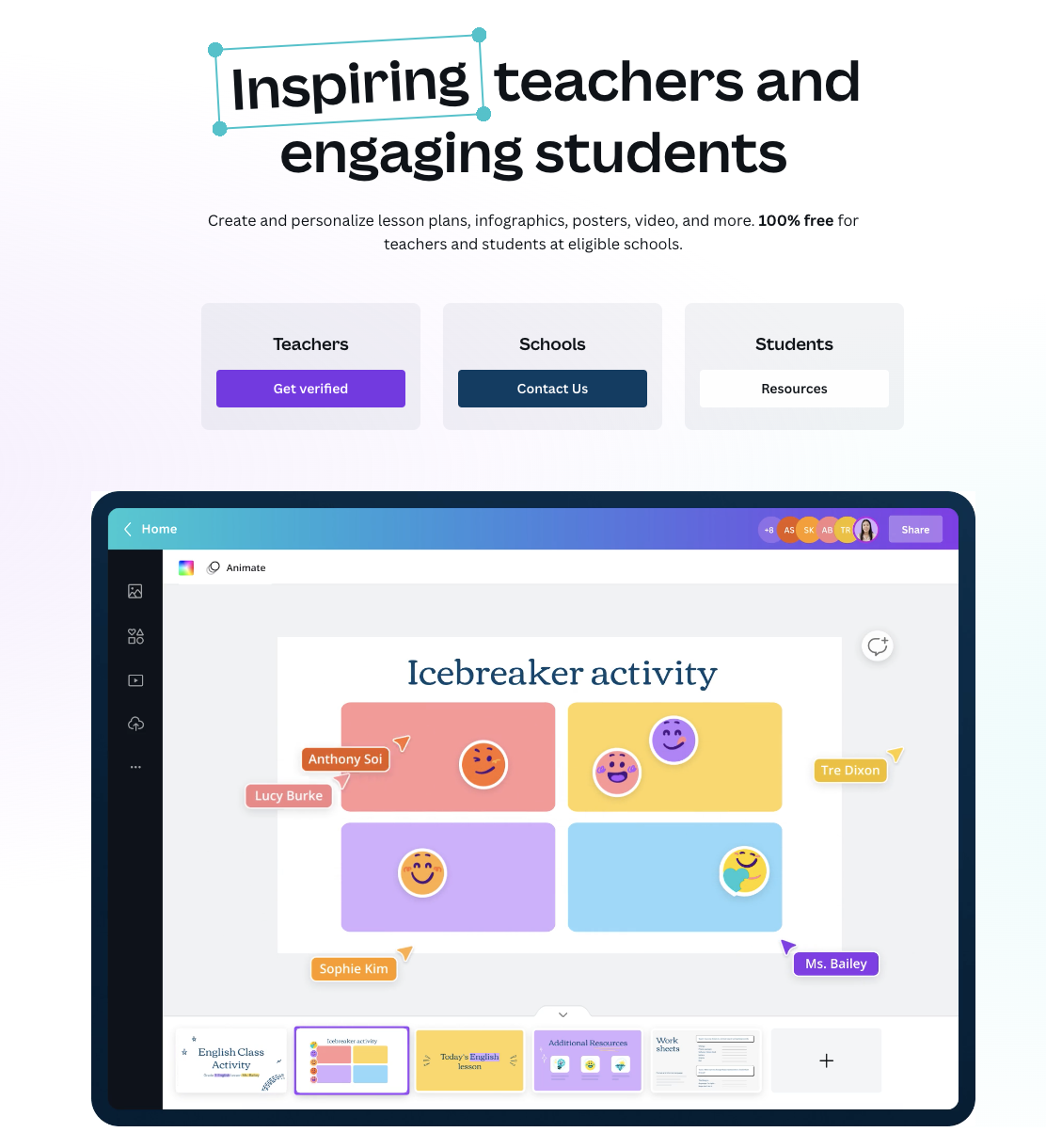
Canva is just such a digital tool. It is a free, online, graphic design tool. With this promotional screen (Figure 1), Canva is first reaching out to teachers with an emotional appeal (Juneja, 2022). A lot has been written about teacher burnout and the drastic shortages of teachers entering the profession; don’t teachers need to feel inspired? (Although, it is presumptuous that they think Canva can do that with a few clicks.) Don’t teachers fear not being able to easily engage students? (Of course they do, but again, digital technology won’t fix that all by itself.) Figure 1 is actually a screenshot of an animation which shows how a Canva presentation can become an interactive activity for teachers and students, thus supporting online collaboration. The animation also shows how the teachers can use the application to address the social and emotional learning needs of their students. The small print under the headline in the Figure 1 indicates that the platform is free to all eligible teachers and their students, an ongoing promotional tactic (Juneja, 2022).

In addition, Canva is now trying to shift its image from a strictly graphic design platform to a presentation and documents platform (Figure 2). For teachers, this dramatically increases the usefulness of Canva for educators by giving them ways to create all of the documents they would ever need for their classrooms. Canva is relying on customer loyalty to encourage teachers to abandon commonly used platforms like Google Docs and Word, and are promoting the new docs tools by inviting users to try it out. For a lot of teachers, even though they know that inspiration and engagement cannot be guaranteed, it would probably be worth a try, especially since it’s free and they wouldn’t have to pay anything for it out of their own pockets. These promises encourage teachers to engage in “immaterial labor” to create “immaterial products” (Selwyn, 2014); the promises imply that stress can be managed by using digital technology.
Analyzing the Ideology of the Advertisement
The message was created by Canva, a design platform developed by Melanie Perkins in 2013. More recently, in December 2019, Canva announced Canva for Education, a free platform for educators that has the potential to facilitate collaboration between students and teachers. Canva is a visual communications platform that gives teachers the ability to “design anything and publish anywhere” ( “Discover Products,” 2022). The ad indicates that the platform has educational templates to use for creating presentations, posters, lesson plans, and infographics, among others, evidence that the founder is sticking to her desire to make design accessible to everyone (Miller, 2022).
Canva focused on a perceived need in schools today–social and emotional learning (SEL) in their advertisement. Although SEL has been studied often during the last few decades (Social and Emotional, 2011), the current emphasis on its importance is an outgrowth of the post-pandemic world, a world in which students are more anxious, depressed, fatigued, and distressed than they were before the pandemic (Elharake et al., 2022). A smart marketer for Canva recognized SEL as a trend in schools and targeted SEL in their advertisement knowing that some teachers would be willing to open the platform specifically to look for this presentation.
Teachers who want to jazz up their classroom offerings or improve their workflow might see Canva as a one-stop shop for all things educational, from presentations and online collaboration to creating lesson plans, worksheets, and infographics. Students would appreciate the creative aspects of the work they see in the ad, and would positively anticipate the possibility of chatting online with their classmates. Administrators would be ambivalent about use of the platform, although if you ask the technology coordinator for a campus or district, they might be concerned about low ratings for student privacy in terms of data collected about its users (Common Sense, 2022).
Canva promises easy, time-saving answers to common problems of practice. The ads promise that the platform is flexible and offers a way for teachers to compose virtually any document in a creative interactive way. The hidden truth is that, while Canva really can offer these benefits, there is a time factor involved in using the Canva platform to produce work. Eventually (speaking from personal experience), the work can be done quickly and efficiently, but the learning curve can be steep.
The underlying message in these advertisements is a belief that teachers apparently need easy solutions to difficult problems. It suggests that Canva is the answer to creating inspirational pieces that automatically ensure inspired activities and student engagement, a promise that is, of course, not true. Technology of any kind is only a tool, one that often comes with baseless promises of instant success. The power of technology, whichever platform is under discussion, lies in how it is used for specific purposes by the individual teacher in their classroom.
Critiquing the Advertisement
Advertisements of this nature are a sign of a deeper problem–the idea that teachers need to be fixed. However, it is not teachers who are broken. Understaffing in public schools has been an ongoing problem for public education; the number of teaching degrees conferred has been declining since the 1970s (Deen, 2022). However, the pandemic has exacerbated the problem. Students are behind, students do need help with social and emotional issues, and teachers are in the ideal position to help (Perna, 2022). In this post-pandemic landscape, administrators have responded by burdening classroom teachers with providing additional measures to help students “catch up” and be “mindful,” and a teacher’s success must be proven with data, data, and more data. Ed tech marketers are eager to jump on the emotional roller coaster that teachers are riding, advertising quick fixes. One report surveyed ed tech use in over 100 districts during the 2021-2022 school year, identifying more than 2,000 apps used across all districts, with 300 of those used most often (Report: K-12, 2022; Lightspeed, 2022).
Selwyn (2019) admonishes that teachers must beware of the promises made by ed tech marketers who claim that they have magic answers to improve teaching and learning, whether it’s inspired content or student engagement. If the use of digital technology in the classroom is to be effective, teachers really need to spend more time, not less, in evaluating its most appropriate uses; it is not a quick or easy, one-size fits all solution (Selwyn, 2019). Every campus, indeed, every classroom, will have different personalities and different triggers that allow learning to take place. Digital technology should not be used by teachers just because they can, or just because the district bought the license. Instead, teachers must be allowed to choose the technology best suited to meet the goals they’ve set for students in their classrooms. All the best market research will not ensure that any one digital platform will work for everyone. Technology is a tool, best wielded by those who have the knowledge about how it might best be used.
References
Behring, S. (2022, April 28). Why social and emotional learning is so important now. Healthline. Retrieved January 14, 2023, from https://www.healthline.com/health/mental-health/social-emotional-learning-important
“Common Sense.” (2022). Common sense privacy evaluation for CANVA – Graphic Design & Video. The Common Sense Privacy Program. (n.d.). Retrieved January 14, 2023, from https://privacy.commonsense.org/evaluation/Canva—Graphic-Design–Video
Deen, A. (2022, October 6). The teacher shortage problem has been going on for 50 years. why are so few entering the profession? Grid News. Retrieved January 14, 2023, from https://www.grid.news/story/politics/2022/10/05/the-teacher-shortage-problem-has-been-going-on-for-50-years-why-are-so-few-entering-the-profession/
“Discover Products.” (2022). Discover products. Index.edsurge.com. Retrieved January 14, 2023, from https://index.edsurge.com/products/
Elharake, J. A., Akbar, F., Malik, A. A., Gilliam, W., & Omer, S. B. (2022). Mental Health Impact of COVID-19 among Children and College Students: A Systematic Review. Child psychiatry and human development, 1–13.
Juneja, P. (2022). Advertising techniques – 13 most common techniques used by the advertisers. Management Study Guide. Retrieved January 14, 2023, from https://www.managementstudyguide.com/advertising-techniques.htm
Lightspeed Systems. (2022, September 6). 2022 ed tech App Report. Lightspeed Systems. Retrieved January 14, 2023, from https://www.lightspeedsystems.com/ebook/ed tech-app-report/
Miller, H. L. (2022, April 5). Melanie Perkins and the rise of the $40B unicorn, CANVA. Leaders.com. Retrieved January 17, 2023, from https://leaders.com/articles/leaders-stories/melanie-perkins/
Perna, M. C. (2022, October 12). Why education is about to reach a crisis of epic proportions. Forbes. Retrieved January 14, 2023, from https://www.forbes.com/sites/markcperna/2022/01/04/why-education-is-about-to-reach-a-crisis-of-epic-proportions/?sh=5dd5c8c078c7
Plato (375 BCE/1991). Republic, trans. Peter Bloom, 2nd edition. New York: Basic Books, II.374d.
“Report: K-12.” (2022, September 20). Report: K-12 students now use 72 separate apps for School. GovTech. Retrieved January 14, 2023, from https://www.govtech.com/education/k-12/report-k-12-students-now-use-72-separate-apps-for-school#:~:text=According%20to%20Lightspeed’s%20ed tech%20App,for%2099%20percent%20of%20use.
Selwyn, N. (2014). Distrusting educational technology: Critical questions for changing times. Routledge, Taylor & Francis Group.
Selwyn, N. (2022, January 28). Teachers and technology: Time to get serious. My College. Retrieved January 14, 2023, from https://my.chartered.college/impact_article/teachers-and-technology-time-to-get-serious/
Shaddix, R. S. (2022, December 13). 10 common ed tech marketing mistakes: What Tech Companies get wrong about selling in education. Forbes. Retrieved January 14, 2023, from https://www.forbes.com/sites/rebeccasadwick/2019/10/21/10-common-ed tech-marketing-mistakes-what-tech-companies-get-wrong-about-selling-in-education/?sh=6543e6d86fad
“Social and Emotional.” (2011, October 7). Social and Emotional Learning: A short history. Edutopia. Retrieved January 14, 2023, from https://www.edutopia.org/social-emotional-learning-history
Wikimedia Foundation. (2022, December 27). Canva. Wikipedia. Retrieved January 14, 2023, from https://en.wikipedia.org/wiki/Canva
 Cultivating Creative Thought